Specification guide · project supply
Birch cutlery packed with poplar boats — the thickness, tolerance and stack count decide whether the order survives the freight.
Quick Answer
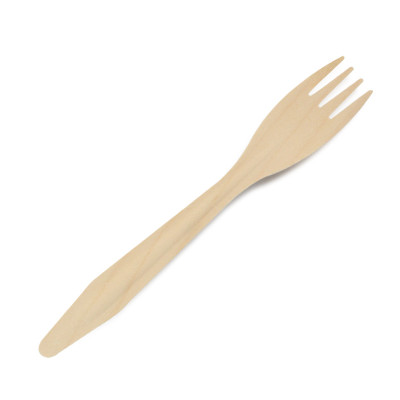
Buy FSC disposable wooden tableware by dimension and tolerance, not by photograph. A 160 × 34 × 1.6 mm birch fork and a 135 × 137 × 14.5 mm poplar boat only work as a system when thickness, edge finish and stack count are specified together.
- Specify thickness at three positions, not one: handle end, neck, tine root.
- Confirm carton quantity and moisture content in writing before booking freight.
- Plan production at 35–45 days from approved shop drawings, not from the purchase order.
Why Most Wooden Tableware Problems Are Millimetre Problems
Most sourcing failures in this category are not certification failures. They are dimensional drift. A fork measured at 1.6 mm on the press line can arrive at 1.5 mm after six weeks in a humid container, and that tenth of a millimetre separates a utensil that snaps cleanly from one that splinters at the tine root in a customer's hand.
Three variables decide whether an order arrives usable: thickness at the stress point, moisture content at the moment of packing, and how the carton is stacked. Everything else is secondary to those three.
We at Leafyest, an FSC disposable wooden tableware manufacturer, cut, press and pack in one facility in Hailin, Heilongjiang, which means the moisture content at packing is a value we control rather than one inherited from a trading company's third-party warehouse.
Why Does Thickness Matter More Than Length on a Wooden Fork?
Length affects how the utensil looks on the table. Thickness decides whether it breaks.
A 160 mm birch fork at 1.6 mm body thickness carries a dessert or a salad without visible flex. Drop below roughly 1.4 mm in the same profile and the tine root becomes the failure point: the fork still looks correct, then gives way on the third or fourth use. A buyer who specifies “160 mm fork” and stops there has specified roughly 40% of what determines whether the product works.
Ask for three thickness measurements, not one
- Handle end — where the thumb loads the utensil.
- Neck — the narrowest section and the usual crack origin.
- Tine or bowl root — where bending stress concentrates.
Each of those three should carry its own tolerance. ±0.1 mm on a 1.6 mm pressed birch section is a realistic commercial tolerance. Asking for ±0.05 mm on a disposable line generally buys a slower press cycle rather than a better utensil.
Stiffness versus length
Stiffness falls with the cube of length for a fixed section. Moving from 140 mm to a reinforced 160 mm fork in the same profile without adding thickness produces a springy utensil.
What to write down
Species, nominal thickness, tolerance and the three measurement positions. Four lines on a purchase order prevent most rejections.
What Wall Thickness Does a Wooden Food Boat Need for Hot, Wet Food?
Boat depth, not boat width, decides whether sauce clears the rim in transit.
For a poplar boat holding curry, sauce or a loaded dessert, we recommend a 1.5–2.0 mm wall with a formed rather than folded base. Below 1.5 mm the boat softens visibly within 20–30 minutes under a hot, wet load. Above 2.0 mm the material stops conforming to the die and the corners begin to crack during forming.
Our reference formats are the small, medium and large wooden boat, plus a birchwood boat in 88 × 50 mm and 147 × 69 mm. Boat depth is the number that decides compatibility with your packaging, not the footprint.
- Match the footprintBoat outer dimensions against the box internal dimensions, allowing 2–3 mm clearance per side.
- Match the depthBoat depth against the tallest component of the served dish, so sauce does not reach the rim.
- Match the stackStacked height of the filled boats against the closed lid height.
System Comparison: Which Wooden Format Fits Which Service Model
Reference dimensions are taken from our current production list. Confirm the drawing set for the exact SKU before committing to a seasonal programme.
Parameter Reference: What Belongs in a Purchase Specification
If your specification sheet cannot answer three of these rows, the quotation you receive is a guess with a price attached. Our engineering team reviews specifications as the first stage of the OEM/ODM process and returns a drawing set before quoting.
How Much Does a Container of Tableware Lose to Dimensional Drift?
Stack height, not carton strength alone, decides whether the top layer keeps its profile.
Wood moves with relative humidity, and it moves across the grain more than along it. A fork cut at 34 mm width changes width before it changes length, which is why width and thickness tolerances matter more than overall length on a purchase specification.
Two mechanisms cause drift between our press and your customer's hand. Moisture uptake in transit lets wood packed at a low moisture content gain moisture and swell, making stacked boats tight in the carton even though no single boat has changed shape. Compression set in stacking applies load to the top layer of a six-high stack, and thin-wall boats take a permanent set.
The defence is not a thicker wall everywhere, which raises cost and weight without addressing the cause. The defence is a written moisture target at packing, a carton compression strength suited to your stacking height, and a stack count that protects the top layer. More on handling is covered in our storage and handling notes.
How Do You Match a Cutlery Kit to a Specific Takeout Container?
Measure the container before you look at a fork. A soup container 70 mm deep needs a spoon whose bowl reaches the bottom while the handle stays clear of the food and below the lid line. A shallow dessert cup needs a shorter utensil so it sits flush inside the closed lid.
That is why our cutlery range runs 96 mm to 200 mm in seven steps rather than offering one length. The working rule we apply in project reviews: utensil length ≈ container depth + 25–40 mm. The margin lets the utensil rest on the rim without the handle sinking.
Then check the kit assembly. A wrapped kit adds film or paper thickness to the footprint, which changes carton count per case. For the 500-set carton, confirm whether the sets are individually wrapped or bulk-packed before you book freight, because the wrapped version occupies measurably more carton volume for the same set count.
What Should a Supplier Quote You Besides Price?
A quotation without dimensions is not a quotation. Five items should appear on every offer for this category.
- Dimensions and tolerancesFor each SKU, at the three thickness positions, not as a single nominal figure.
- Carton quantity and carton sizeThe 500-set carton drives your landed freight per set, not the unit price.
- Moisture content at packingAnd the packaging used to hold it through transit.
- Lead time with a defined start pointOurs runs 35–45 days from approved shop drawings, not from the purchase order date.
- Certificate referencesFSC certificate number, issuing body and the scope statement that names the product types covered.
If any of those five is missing, the offer cannot be compared with another supplier's on equal terms. The same drawing discipline that governs project supply is described in our full wooden tableware range and in the B2B buyer's guide to responsible sourcing.
Where Does the FSC Claim Actually Sit in the Specification?
The FSC claim attaches to the material chain, not to the finished shape. What a buyer needs to verify is that the wood in the specific SKU was sourced through a certified chain of custody and that the certificate covers the product category being purchased.
Request four things: the certificate number, the issuing certification body, the validity dates, and the scope statement naming the product types covered. A certificate covering a mill's timber trading activity is not automatically the same scope as a converted cutlery line. Publication of a logo is not verification.
The full range sits under the FSC disposable wooden tableware group, with cutlery split out under FSC disposable wooden cutlery.
How Do You Plan a Rollout Around a 35–45 Day Lead Time?
Lead time starts at drawing approval, not at order placement, and that single distinction reorganises a rollout schedule. Count backwards from your go-live date.
- Tooling and shop drawings — complete before the clock starts.
- Production — 35–45 days from approved drawings.
- Sea freight and customs — add your own transit and clearance window.
- Local distribution — your last-mile to sites.
A restaurant group with a fixed opening date needs drawing approval roughly three months earlier. Buyers who read lead time as six weeks from the purchase order and then discover the drawing review took ten days are the ones who pay for air freight.
For multi-container programmes, release the first container against the approved drawing and hold the second release until the first has been inspected in your own warehouse. That is cheaper than correcting a full run.
Which Specification Choices Cost Money and Which Do Not?
Costs money
Tolerances tighter than the process supports, unusual profiles needing new tooling, thickness increases that raise material per unit, and low stack counts that raise packaging cost per set.
Costs little or nothing
Naming the three measurement positions, stating species per part, confirming carton quantity, asking for moisture content in writing, matching utensil length to container depth.
The cheapest improvement available to most buyers is to stop sourcing cutlery, boats and plates from three suppliers with three wood species and three moisture regimes. A single-origin system behaves consistently in transit because it was packed under one set of conditions. We manufacture the full range under one roof for exactly that reason.
What Does a Fit-for-Purpose Order Look Like in Practice?
A hospitality group running 40 outlets specified three SKUs: a 160 mm birch spoon, a 140 mm birch fork and a 135 × 137 × 14.5 mm poplar boat. The specification carried ±0.1 mm on the spoon neck, 1.8 mm nominal wall on the boat, 500 sets per carton, and a written moisture target at packing.
The first container was inspected in the buyer's own warehouse before the second release was authorised. Two boats per carton in the top layer showed slight rim flattening, traced to a six-high stack in a warm dock. The correction was a four-high stacking instruction and a revised carton mark — not a product change and not new tooling. That is what a good specification buys: a fixable problem instead of an unusable shipment.
Frequently Asked Questions
What thickness should a wooden fork be?
1.6 mm nominal at the body with ±0.1 mm tolerance, measured at the handle end, neck and tine root. Below roughly 1.4 mm the neck becomes the failure point.
What wall thickness does a wooden food boat need for wet food?
1.5–2.0 mm with a formed base. Our reference boat is 135 × 137 × 14.5 mm — confirm depth against the tallest component of the served dish.
How long does production take?
35–45 days from approved shop drawings. Drawing approval, not the purchase order date, starts the clock.
Can you confirm dimensions and tolerances before we order?
Yes. Send the container dimensions and the service model and our engineers return a drawing set with tolerances marked.
Does the FSC certificate cover the finished cutlery?
The certificate has a defined scope. We provide the number, issuing body, validity dates and scope statement on request so you can verify coverage for the specific SKU.
How many cutlery sets fit in a carton?
500 sets per carton for our standard cutlery sets. Wrapped and bulk-packed kits occupy different carton volumes, so confirm the packing method before booking freight.
Send Us the Container, Not Just a Product Code
The fastest route to a usable specification is a short message with four lines: the container dimensions you fill, the monthly volume you expect, the service model, and your target go-live date. Our engineers return a drawing set with dimensions, tolerances and a production window marked against it.
The article above is written by our own production team, so the numbers in it are the numbers we build to. If a figure in your existing specification looks unfamiliar, ask us to check it against the drawing before you place the order.