Ice cream sticks are a commodity line until the specification, documentation and lead time decide the outcome.
B2B Sourcing Guide
How to Choose a Wooden Popsicle Stick Manufacturer: MOQ, Certifications & Lead Time
Choosing a wooden popsicle stick manufacturer is not a price comparison exercise. Two suppliers can quote within a few percent of each other and still produce completely different outcomes: one delivers consistent dimensions, clean food-contact surfaces and paperwork that clears customs without a second look; the other creates a year of re-work, rejected containers and re-specified tooling.
This guide walks through the criteria that actually separate suppliers — raw material and species, dimensional tolerance, food-contact compliance, FSC chain of custody, MOQ, tooling, lead time and packaging — so procurement teams and ice cream brands can qualify a supplier on evidence rather than on a quotation.
What a Popsicle Stick Manufacturer Actually Controls
It helps to know which variables sit inside the supplier's control, because those are the ones worth negotiating.
- Raw material species and grade: birch is the standard for ice cream sticks because it is fine-grained, low-odour and machines cleanly. Grade determines how many sticks carry visible defects.
- Dimensional tolerance: length, width, thickness and edge profile. This is the single most consequential specification for automated stick insertion.
- Surface and edge finish: splinters and raised grain are a food-safety issue, not a cosmetic one.
- Moisture content: affects stability, warping and how the stick behaves in a freezer environment.
- Certification and chain of custody: FSC or equivalent, plus food-contact declarations.
- Packaging and carton configuration: how the sticks arrive determines how they feed into your line.
Bevelled, Straight and Magnum: Matching Format to Product
Bevelled edge
A tapered edge that enters moulds smoothly and reads as a more finished product. Common for premium and branded ice cream bars.
Straight edge
The conventional flat profile. Economical, widely compatible and the default for high-volume standard production.
Magnum format
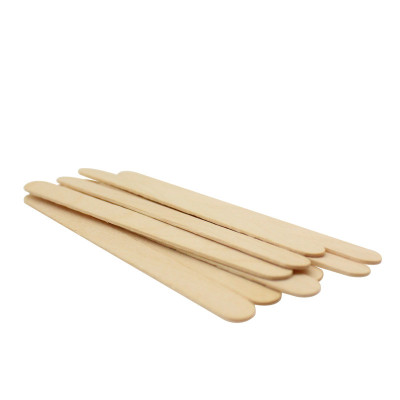
A wider 17 mm profile at 72 mm or 94 mm length for larger, heavier bars where a standard stick would flex or feel undersized.
If the format choice is still open, the practical sequence is to fix the product size and weight first, then select the stick format that carries it without flexing — not the other way around.
Food-Contact Compliance and Documentation
For a retail or foodservice buyer, documentation is not a formality. An undeclared or missing certificate can hold a container at port, and the cost of that delay usually exceeds the entire saving that prompted the switch.
The document set to request before the first order
- FSC chain-of-custody certificate with a valid certificate code that can be verified against the issuing body
- Food-contact compliance declaration referencing the applicable regulation for your destination market
- Specification sheet stating dimensions, tolerances, moisture range and species
- Batch or lot identification so deliveries can be traced back to production records
- Packaging declaration covering carton material and any plastic inner liners, which affect recyclability claims
Verify, do not assume
Ask for the certificate number and check it independently rather than accepting a scanned copy at face value. Suppliers who hold genuine chain-of-custody certification expect the check and answer it immediately.
More detail on what certification does and does not cover is set out in our FSC disposable tableware B2B buyer's guide.
MOQ: What It Really Depends On
Minimum order quantity for wooden ice cream sticks is not a single fixed number, and suppliers who quote one without asking questions are usually quoting a warehoused catalogue item rather than a manufactured specification.
A supplier that can explain why the MOQ sits where it does is a supplier that can also tell you which lever to change to bring it down — for example accepting a standard carton count instead of a custom one.
Lead Time, Capacity and Supply Reliability
Lead time should be broken into its parts, because the total is what affects your production plan, not the production time alone.
- Sampling and approvalThe time to produce and ship a sample, plus your own internal approval and any consumer testing.
- ToolingApplies to custom dimensions and profiles. Tooling is the longest single item in a first order and disappears on repeat orders.
- ProductionDependent on capacity at the time of order, not on capacity in general. Ask what the seasonal peak looks like.
- Quality inspectionWhether in-house or third-party, and whether it is included in the quoted timeline.
- Inland and ocean transitPort selection, sailing frequency and any consolidation. This usually exceeds the production time.
- Customs clearance at destinationDirectly affected by how complete the documentation set is.
The capacity question that matters
Ask what happens to your lead time during the peak ice cream season. A supplier whose quoted lead time assumes off-peak capacity will disappoint exactly when you need volume most.
Quality Signals to Check Before Committing
Sample consistency
Order samples twice, weeks apart. If the second sample differs from the first, batch consistency is not under control.
Defect rate disclosure
A supplier willing to state an expected defect rate and how it is measured is far easier to work with than one promising zero defects.
In-house vs. outsourced
Confirm whether your specification is produced on the supplier's own line or brokered to a third party who may change without notice.
Response behaviour
How a supplier handles a technical question before the order is a reliable predictor of how they handle a problem after it.
Working with Leafyest as Your Stick Supplier
Leafyest manufactures FSC-certified disposable wooden ice cream sticks and a full disposable wooden and bamboo tableware range for ice cream brands, foodservice distributors, importers and private label retailers. We support OEM and ODM development across stick dimensions, edge profile, carton configuration and private label packaging.
Request a sample and OEM/ODM consultation
Frequently Asked Questions
What is the most common ice cream stick size?
93×10×2 mm and 114×10×2 mm cover the majority of standard ice cream and popsicle production. Larger bars generally move to a Magnum format at 72×17/11×2 mm or 94×17/11×2 mm.
Is FSC certification mandatory for wooden ice cream sticks?
It is not universally mandatory, but a growing number of retail buyers and European markets require chain-of-custody documentation as part of their sustainability commitments. It is significantly easier to specify it from the start than to add it later.
Can popsicle sticks be printed with our brand?
Yes. Branded sticks are available, but the printing ink must also meet food-contact requirements for your destination market, so approval takes longer than unprinted stock.
How should wooden ice cream sticks be stored after delivery?
In a dry, ventilated area away from direct heat and moisture, keeping cartons sealed until use. Humidity is the main risk because it affects moisture content and therefore dimensional stability.
Do smaller trial orders count toward the MOQ?
Often a first order can be arranged below the standard MOQ to validate fit and quality, particularly where a longer-term volume is planned. Discuss it before assuming the published minimum is fixed.